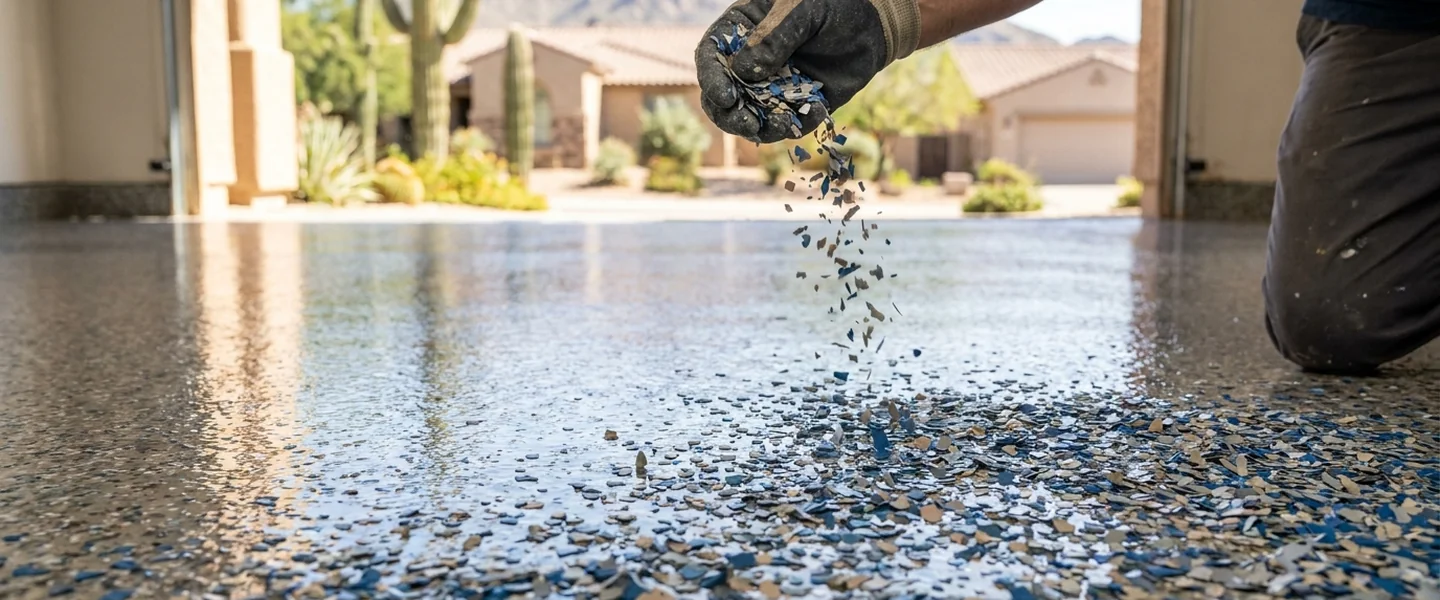
Garage Floor Epoxy in Phoenix, AZ
Diamond-grind prep, premium broadcast flake, and UV-stable polyaspartic topcoats for Phoenix garages — one-day installs, 15-year product warranty.
Call Now: (602) 975-5035A garage floor epoxy install in Phoenix is only as durable as the prep underneath it. Most failed coatings in Maricopa County — the ones that peel, blister, or get lifted by hot tires within the first 2 years — failed because the contractor used acid etching or no prep at all, applied a single thin coat over uncleaned concrete, and skipped the UV-stable topcoat. Phoenix Epoxy Floor Pros installs proper systems: full diamond grind to expose fresh concrete profile, vapor-block primer where moisture testing indicates, broadcast flake to chip rejection, and a polyaspartic topcoat that handles Phoenix UV and 115°F summer heat. Call (602) 975-5035 for a free written estimate.
Why Garage Floor Epoxy Fails in Phoenix
Three failure modes dominate Phoenix garage floor coating callbacks, and all three are prevented at the prep stage:
Hot tire pickup. When summer pavement temperatures reach 160°F, tires absorb that heat and stay hot when parked. A coating bonded only by chemical etching transfers under that heat into the tire tread — peeling the coating off the slab in patches that look like tire footprints. The fix is mechanical bond via diamond grinding, not chemical etching. Phoenix sees this failure mode more than any other market in the country because of summer pavement temperatures.
UV chalking and yellowing. Standard epoxy resins yellow and chalk under UV exposure. Even garage interiors get indirect UV through open doors and windows. Polyaspartic topcoats are UV-stable — they keep their original color and gloss for 15+ years in Phoenix sun. Every system we install gets a polyaspartic topcoat regardless of base resin.
Moisture vapor blistering. Despite Phoenix's dry climate, slab moisture vapor emission (MVE) is a real and underdiagnosed problem. Monsoon rains and daily temperature cycling drive moisture up through slabs that lack adequate vapor barriers. A coating applied over an active MVE source blisters within months. We test slab moisture before quoting and specify a vapor-block primer where indicated.
Project Details
| Service | Residential Garage Floor Epoxy / Polyaspartic Coating |
|---|---|
| Timeline | One day (polyaspartic system) or two days (traditional epoxy system) |
| Surface Prep | Diamond grinding to CSP 2–3 profile; vapor-block primer where moisture testing indicates |
| Base Coat | 100% solids epoxy or polyaspartic basecoat — chemical bond to ground profile |
| Flake System | Premium acrylic chip broadcast to rejection — typical chip size 1/4"; custom colors available |
| Topcoat | UV-stable polyaspartic topcoat — clear or tinted, satin to high-gloss finish |
| Warranty | 15-year product warranty + 5-year workmanship warranty, transferable |
| Pricing | Quoted per job after free on-site estimate — every quote itemized in writing |
Our Installation Process
- 1Free on-site estimate. We measure square footage, assess slab condition (cracks, divots, prior coatings, moisture), and recommend the appropriate system. The written estimate specifies materials, prep scope, and warranty terms.
- 2Surface preparation. Diamond grinding with industrial planetary grinders to expose fresh concrete and create a CSP 2–3 profile for mechanical bond. Vacuum-extracted dust collection — no slurry, no concrete dust on adjacent surfaces. Cracks routed and filled with semi-rigid polymer; divots patched.
- 3Vapor-block primer (where indicated). Slab moisture testing determines whether a vapor-block primer is needed. If yes, the primer is applied and allowed to cure before basecoat — Phoenix slabs vary, and this isn't a one-size-fits-all decision.
- 4Basecoat application. 100% solids epoxy or polyaspartic basecoat rolled at specified mil thickness. Tinted to match the chip blend so any future scratch reveals matching color underneath, not contrasting concrete.
- 5Chip broadcast. Premium acrylic chips broadcast into the wet basecoat to rejection — meaning we keep throwing chips until no more bond to the resin. Full coverage prevents bare-spot visibility and gives uniform texture.
- 6Chip scrape and topcoat. After basecoat cure, loose chips scraped to expose the profile, then polyaspartic topcoat rolled. The topcoat encapsulates the chips, locks in the system, and provides UV stability and chemical resistance.
- 7Walk-on / drive-on. Walk on within 4–6 hours, park on within 24 hours for polyaspartic systems. We walk you through the maintenance specs before we leave.
Materials We Use
| Component | Brand / Specification |
|---|---|
| Epoxy Basecoat | Wolverine Coatings or Citadel 100% solids epoxy |
| Polyaspartic Topcoat | Penntek or PolyTek polyaspartic — UV-stable, low-VOC |
| Vapor-Block Primer | Single-component MVE-mitigating epoxy primer |
| Chip System | Torginol, Torchstar, or custom-blended acrylic chips |
| Crack Repair | Semi-rigid polymer (polyurea) for moving cracks; epoxy gel for static |
Common Phoenix Garage Scenarios
New-Construction Three-Car Garage
Common scenario in Gilbert, Chandler, and Peoria new-build subdivisions. Fresh slab requires 28-day cure before coating; we schedule accordingly. Two-day install for traditional epoxy or one-day for polyaspartic. Premium flake patterns for resale value.
Failed DIY or Big-Box Kit
The most common pre-existing condition we encounter — homeowner installed a Rust-Oleum or similar paint-kit coating that has peeled, lifted by hot tires, or failed at the corners. Full removal via diamond grinding back to bare concrete before our system goes down.
Hot Tire Lift on Older Coating
An aging acid-etched epoxy job that survived 5–10 years but is now showing hot-tire pickup as the bond degrades. We grind off the failed coating and install a properly bonded polyaspartic system that won't repeat the failure.
Workshop or Hobby Garage
Customer using the garage as a workshop — needs chemical resistance for oils, solvents, and battery acids; needs slip resistance for safety; needs aesthetic durability for a space where they spend significant time. Premium chip + polyaspartic topcoat handles all three.
Warranty in Detail
Our 15-year product warranty covers manufacturer-defect failures in the coating materials. Our 5-year workmanship warranty covers installation defects — adhesion failure, blistering, or finish irregularities caused by application error. Both warranties are transferable to subsequent homeowners at no charge with written notification.
What the warranty does not cover: damage from concrete failure below the coating (slab heaving, new crack propagation from foundation movement), damage from impact or dropped tools, chemical exposure beyond the rated chemical resistance of the topcoat, or modifications to the coating by other contractors. These exclusions are standard in the industry and reflect the limits of what a coating warranty can reasonably cover — the coating cannot stabilize a moving slab below it.
How We Quote (Without Quoting on the Phone)
We don't quote garage floor installs over the phone because the price depends on what we find at the slab. Square footage is the starting point, but slab condition matters: existing coating to remove, cracks to repair, moisture issues to address, and the chosen system (one-day polyaspartic vs. two-day epoxy) all affect the scope. A phone quote that doesn't account for these is either inflated to cover unknowns or low to win the call. We schedule the free on-site estimate, inspect the slab, and provide an itemized written quote you can hold us to.
After the Install — Care and Maintenance
Walk on within 4–6 hours of the final coat. Light foot traffic the same evening. Park on within 24 hours for polyaspartic, 48–72 hours for traditional epoxy. For the first 30 days, avoid harsh chemicals on the surface — let the topcoat reach full cure. For ongoing maintenance: sweep regularly, mop with mild detergent, clean spills promptly. Avoid acidic cleaners, which can dull the topcoat. The coating doesn't need waxing or resealing — the polyaspartic is the topcoat, not a sacrificial layer.
Garage Floor Epoxy FAQs — Phoenix, AZ
How long will an epoxy garage floor last in Phoenix?
A properly installed polyaspartic system — diamond-ground prep, full chip broadcast, UV-stable topcoat — typically lasts 15+ years in Phoenix conditions. The polyaspartic topcoat is what makes the difference; without it, even a well-installed epoxy coating will yellow and chalk under UV exposure within 5–7 years.
Epoxy vs polyaspartic — which is right for my Phoenix garage?
For Phoenix, we typically recommend a hybrid system: 100% solids epoxy basecoat (deeper penetration, better cost-effectiveness on the base layer) with a polyaspartic topcoat (UV stability, faster cure, scratch resistance). Pure polyaspartic systems work too and are appropriate for one-day install timelines. We specify the system at the estimate based on your priorities.
Can you install in the summer when it's 115°F outside?
Yes. We schedule summer installs for early morning when ambient garage temperature is still manageable. Material formulations are temperature-rated for Phoenix conditions. The dry climate is actually favorable for cure compared to humid southern markets where high humidity slows polyaspartic cure.
How long until I can park on the new floor?
For polyaspartic: walk on within 4–6 hours, park on within 24 hours. For traditional epoxy: walk on within 12–24 hours, park on within 48–72 hours. We confirm the specific timing for your install at scheduling.
Will hot tires lift the coating in summer?
Not with our prep. Hot tire pickup happens when a coating is bonded only by chemical etching, not mechanical profile. Our diamond grinding produces a CSP 2–3 profile that creates true mechanical bond — the coating is locked into the concrete substrate, not just adhered to the surface. This is the prep that DIY kits and many cut-rate installers skip.
Is the floor slippery when wet?
The chip broadcast itself provides texture that significantly reduces slipperiness compared to a smooth coating. For garages used as workshops or for households with high slip-injury risk, we can add an anti-slip aggregate to the topcoat for additional grip. This is a check-box option on the estimate.
Do you do garage floors on new construction?
Yes — we work with homeowners closing on new-construction homes in Gilbert, Chandler, Peoria, and across the Valley. Note that new concrete needs to cure 28 days minimum before coating. We schedule accordingly.
Can you remove an existing failed coating?
Yes. We diamond-grind off failed coatings — DIY paint kits, peeling acid-etched epoxy, old painted floors — back to bare concrete profile, then install the new system. Removal is part of the scope when needed, specified in the written estimate.
Phoenix-Specific Considerations
Maricopa County's three biggest garage floor coating considerations are: summer slab temperatures (hot tire pickup risk), UV exposure even on interior surfaces (chalking risk), and monsoon-driven slab moisture (blistering risk). Every install we do accounts for all three. The polyaspartic topcoat is the UV solution; diamond grinding is the hot tire solution; moisture testing and vapor-block primer where needed is the monsoon solution. None of these are upgrades — they're standard scope for any installation we warranty.
Phoenix-area new construction in Gilbert, Chandler, Peoria, and the West Valley has produced large 3-car and 4-car garages where homeowners are using the space for hobbies, workshops, or daily-driver storage. The premium coating systems we install reflect the way Phoenix homeowners actually use these spaces — not just car parking, but functional workshop and storage areas that benefit from a durable, chemical-resistant finish.
Free Garage Floor Epoxy Estimate in Phoenix, AZ
Diamond-grind prep, polyaspartic topcoat, 15-year warranty. Same-week estimates across Maricopa County.
Call (602) 975-5035Related reading: Polyaspartic Coatings | Metallic Epoxy Floors
What You Get in Our Quote vs. the Lowball Bid
We don't compete on the lowest sticker price — we compete on the quote that gets the job actually done. Here is what is included in every quote we write, and the cut-corners that show up in cheaper bids.
Included in our written quote
- Concrete moisture + porosity testing
- Crack and pitting repair before coating
- Full diamond-grind surface prep
- Written quote with flake/coat specs
- Cure-time schedule you can plan around
- 5-year warranty against delamination
Cut corners in the lowball bid
- Coating over uncured or wet slab
- Roller-only prep (no diamond grind)
- Lowball quotes without crack repair
- Subbed-out installation
- No moisture testing before coat
- Warranties full of fine print