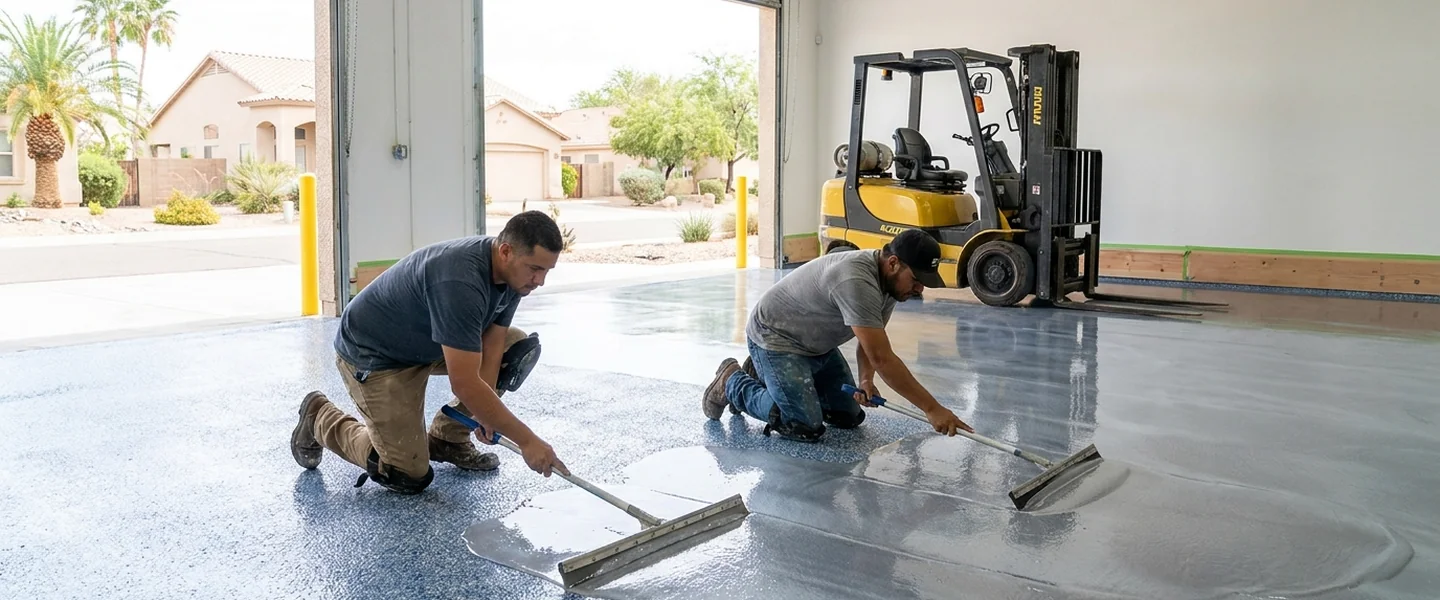
Commercial Epoxy Flooring in Phoenix, AZ
High-traffic epoxy and polyaspartic systems for Phoenix warehouses, auto shops, clinics, kitchens, and retail spaces — chemical-resistant, ASTM-rated slip resistance, scheduled around your operations.
Call Now: (602) 975-5035Commercial epoxy flooring in Phoenix requires more than a thicker version of the residential product. Different operational conditions — heavy forklift traffic, chemical exposure, food-safety requirements, healthcare cleaning protocols, retail aesthetics — each drive a different system specification. Phoenix Epoxy Floor Pros installs commercial systems tailored to the operational requirement: chemical-resistant epoxy for auto shops and industrial chemical handling, USDA-compliant urethane cement for food production and processing, anti-microbial polyaspartic for medical and dental clinics, and decorative quartz broadcast systems for retail and showroom applications. We schedule around your operations including off-hours and weekend installs. Call (602) 975-5035 for a free site assessment.
Commercial Floor System Selection
The right floor system depends on operational requirements, not just budget. Commercial coating specification involves four key questions:
What chemicals will the floor see? Auto shops face motor oil, antifreeze, brake fluid, battery acid. Restaurants face fats, oils, food acids, cleaning chemicals. Medical clinics face bleach, alcohol, biological waste. Each requires a topcoat with rated chemical resistance for the specific exposure.
What traffic load will the floor see? Foot traffic only? Pallet jacks? Forklifts? Vehicles? Each load class drives a different total system thickness and a different basecoat formulation. A thin retail floor doesn't survive forklift traffic; an industrial-grade warehouse floor is overkill for a clinic waiting room.
What slip resistance is required? OSHA, food-safety, and ADA standards specify minimum slip resistance for various commercial environments. We rate the topcoat and add anti-slip aggregate where the operational requirement demands it. ASTM D2047 slip-resistance testing is the standard reference.
What downtime is acceptable? A restaurant closing for 5 days isn't acceptable; a one-day polyaspartic Sunday install is. An auto shop can sometimes lose 48 hours over a weekend. Project scheduling drives system selection just as much as the technical specification.
Project Details
| Service | Commercial Epoxy / Polyaspartic / Urethane Cement Flooring |
|---|---|
| Timeline | Site-specific — 1 day for small polyaspartic, multi-phase for large industrial |
| Industries Served | Auto shops, warehouses, healthcare, food service, retail, manufacturing, government facilities |
| Chemical Resistance | System-specific ratings; we specify based on chemical exposure assessment |
| Slip Resistance | ASTM D2047 compliant where required; anti-slip aggregate optional in topcoat |
| Off-Hours Work | Available — nights, weekends, scheduled around operations |
| Warranty | System-specific; typically 5–10 year workmanship + product manufacturer warranty |
| Pricing | Quoted per project after free on-site assessment |
Our Commercial Install Process
- 1Free site assessment. We meet at your facility to understand the operational context: traffic patterns, chemical exposure, regulatory requirements, and scheduling constraints. The assessment is the basis for the system specification, not just square footage.
- 2System specification and written proposal. We specify the basecoat, optional intermediate coats, topcoat, and anti-slip aggregate based on the requirements. The proposal documents the system, materials, warranty, and timeline. No vague "epoxy floor" language.
- 3Schedule coordination. Most commercial installs require coordination with facility operations. We schedule off-hours and phase installs across multiple nights or weekends when needed. Critical: the floor is unusable during cure — we plan around that.
- 4Surface preparation. Diamond-grinding to the specified surface profile. Existing failed coatings removed completely. Cracks repaired, joints handled appropriately for the operational environment. For food and medical applications, additional cleaning protocols apply.
- 5System application. Basecoat, intermediate coats (where specified), and topcoat applied per manufacturer specification. Quality control checks at each layer — no shortcuts on prep timing or cure times between coats.
- 6Final inspection and handoff. Walk-through with facility management, documentation of installed system, warranty documents, and maintenance recommendations specific to the operational environment.
Common Commercial Applications in Phoenix
Auto Service Shops
Chemical-resistant epoxy with polyaspartic topcoat for auto repair bays, lube shops, body shops, and tire stores. Resists motor oil, brake fluid, antifreeze, and battery acid. Slip-resistant for wet conditions.
Warehouse and Distribution
Heavy-duty industrial systems for forklift and pallet-jack traffic. Color-coding for safety lanes and zone designation. Joint repair for jointed slabs with material movement.
Medical and Dental Clinics
Anti-microbial polyaspartic systems with seamless cove base for healthcare facility cleaning protocols. Bleach and alcohol-resistant topcoats. ASTM-rated slip resistance.
Restaurant Kitchens
USDA/FDA-compliant urethane cement systems for food preparation areas. High slip resistance for wet kitchen environments. Resistance to fats, oils, food acids, and steam cleaning.
Retail and Showroom
Decorative quartz broadcast or metallic epoxy systems for customer-facing retail spaces. Aesthetic finish with commercial-grade durability. Scheduled around store hours.
Manufacturing and Light Industrial
System-specific to the manufacturing process — chemical handling, equipment loading, foot traffic. Static-dissipative options available for electronics manufacturing.
Materials We Use
| System Type | Material Spec |
|---|---|
| Industrial Epoxy | Wolverine or Citadel 100% solids — 12+ mil total thickness for heavy traffic |
| Polyaspartic Topcoat | Aliphatic polyaspartic with chemical-resistance additives |
| Urethane Cement | Three-component urethane cement — USDA/FDA-compliant for food applications |
| Anti-Microbial Additive | Silver-ion or organic-biocide additives for healthcare topcoats |
| Static-Dissipative | ESD-rated topcoat for electronics manufacturing environments |
| Quartz Broadcast | Colored quartz aggregate broadcast for decorative commercial applications |
How We Schedule Around Operations
Commercial floor coating projects almost always require coordination with facility operations because the floor is unusable for hours after the topcoat. We work with facility management to identify the schedule that minimizes operational impact:
Single-shift facilities typically get a weekend install — Friday evening through Sunday afternoon cure, with operations resuming Monday morning.
24/7 operations require phased installs — sectioning the floor and coating one area at a time while operations continue in adjacent areas. We sequence the phases to minimize traffic crossing fresh coatings.
Retail with daytime hours gets overnight installs scheduled between close and open. Polyaspartic systems are the right choice here for the 4–6 hour walk-on cure.
Restaurants typically use the slow night of the week (often Monday or Tuesday) for closure. Urethane cement systems for kitchen floors need 8–10 hours between coats, so phased installs across multiple nights are sometimes appropriate.
Warranty in Detail
Commercial warranty terms vary by system. A standard chemical-resistant epoxy + polyaspartic topcoat for an auto shop typically carries a 10-year product warranty and 5-year workmanship warranty. Urethane cement systems for food applications have similar terms with USDA/FDA documentation. Static-dissipative systems may include ESD performance warranty in addition to material warranty.
What commercial warranties typically exclude: damage from operations outside the rated load class, chemical exposure beyond rated resistance, damage from equipment installation or modification, and structural concrete failure. We specify the exact warranty terms in the project proposal, including the failure modes covered.
Commercial Epoxy FAQs — Phoenix, AZ
How long will my Phoenix commercial floor be unusable?
Depends on the system. Polyaspartic: 4–6 hours to walk on, 24 hours to vehicle traffic. Standard epoxy: 12–24 hours to walk on, 48–72 hours to vehicle traffic. Urethane cement: 24–48 hours full cure. We coordinate schedule explicitly with facility management before quoting timeline.
Can you install during business hours, or is it always after-hours?
Most commercial installs are scheduled after-hours because the floor is unusable during cure. We do daytime installs in unoccupied portions of a facility where the schedule allows. Specific scheduling is discussed at the assessment.
Is the floor USDA-compliant for food production?
Our urethane cement systems are USDA/FDA-compliant for direct and indirect food contact areas. Standard epoxy systems are not — they're typically not specified for food production areas in regulated facilities. The system selection happens at the assessment based on regulatory requirements.
Will the floor meet ADA slip-resistance requirements?
Yes, when the spec calls for it. ADA-compliant slip resistance (typically referencing ASTM D2047 testing standards) is achieved by adding anti-slip aggregate to the topcoat. We specify the aggregate type and topcoat formulation appropriate for ADA compliance in the project proposal.
Can you do colored safety markings on the floor?
Yes. Multi-color systems with safety lanes, zone designation, equipment outlines, or directional markings are standard for warehouse and manufacturing applications. The markings are part of the coating system — not paint applied over the topcoat — so they have the same durability as the floor itself.
How much does commercial epoxy flooring cost in Phoenix?
Call (602) 975-5035 for a site assessment and written proposal. Commercial pricing depends on system selection, total square footage, prep scope, scheduling complexity, and warranty terms. Every project quoted with itemized written documentation.
Phoenix Commercial Market Considerations
Phoenix's commercial real estate market — particularly the industrial corridors along I-10, the Loop 101 logistics zones, and the Sky Harbor airport-area commercial properties — has significant commercial floor coating demand driven by warehouse and distribution operations. Phoenix's auto-shop density is also among the highest in the country given the metro's automotive culture and dealership infrastructure. Both market segments are familiar territory for commercial floor coating installs.
Phoenix's medical and dental clinic growth — particularly in the East Valley (Mesa, Chandler, Gilbert) and the new clinical campuses in Scottsdale and northwest Phoenix — has produced ongoing demand for healthcare-grade flooring systems. The anti-microbial polyaspartic + seamless cove base specification is the modern standard for these facilities, and we install it regularly across the Phoenix metro.
Commercial Epoxy Flooring in Phoenix, AZ
Site-specific system spec, off-hours scheduling, full warranty documentation. Free site assessment across Maricopa County.
Call (602) 975-5035Related reading: Garage Floor Epoxy | Concrete Repair + Coating
What You Get in Our Quote vs. the Lowball Bid
We don't compete on the lowest sticker price — we compete on the quote that gets the job actually done. Here is what is included in every quote we write, and the cut-corners that show up in cheaper bids.
Included in our written quote
- Concrete moisture + porosity testing
- Crack and pitting repair before coating
- Full diamond-grind surface prep
- Written quote with flake/coat specs
- Cure-time schedule you can plan around
- 5-year warranty against delamination
Cut corners in the lowball bid
- Coating over uncured or wet slab
- Roller-only prep (no diamond grind)
- Lowball quotes without crack repair
- Subbed-out installation
- No moisture testing before coat
- Warranties full of fine print