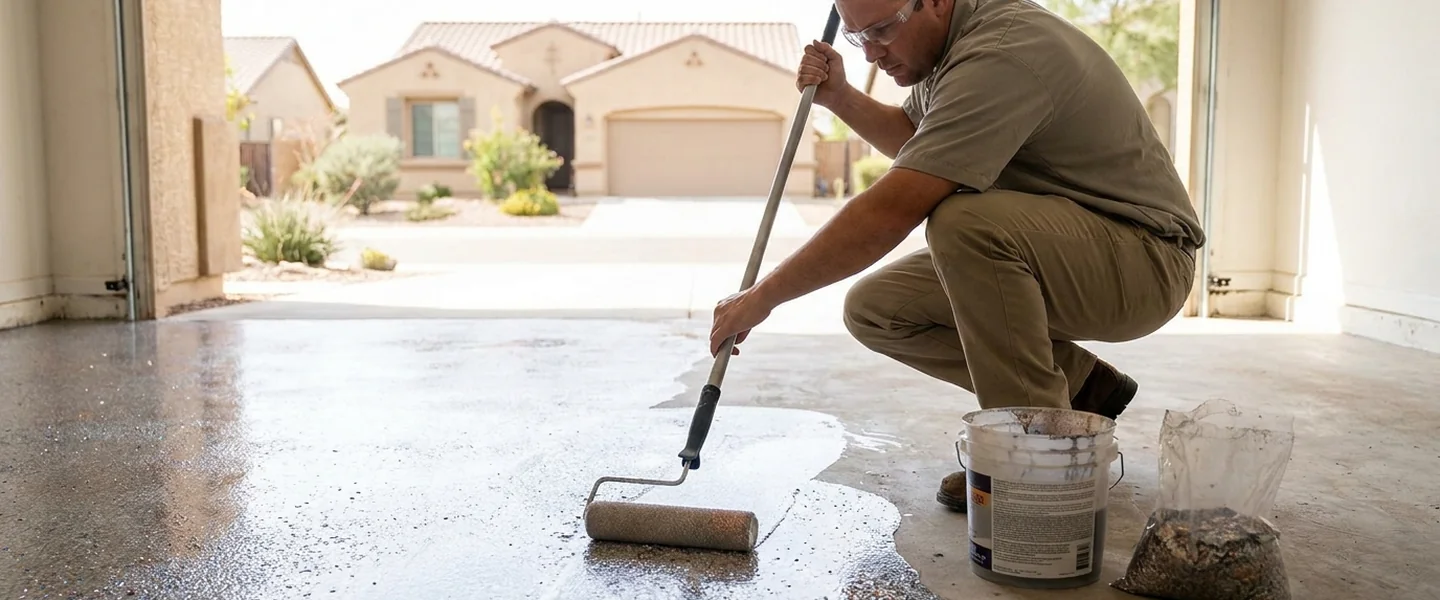
Concrete Floor Repair and Coating in Phoenix, AZ
Crack repair, divot fill, and full surface resurface before coating — restoring degraded Phoenix slabs in one mobilization, ready for a 15-year coating system.
Call Now: (602) 975-5035A coating is only as good as the concrete underneath it. Many Phoenix slabs — particularly in 1970s–1990s garage construction, older commercial buildings, and pool decks reaching end-of-life — have surface damage that prevents a coating from bonding properly or looking right. Phoenix Epoxy Floor Pros does concrete repair and coating as one job: we repair cracks, fill divots, resurface spalled areas, and then apply the coating system over the restored surface. The result is a coating that bonds correctly, looks even, and is warranted as a complete system — not a coating applied over compromised concrete that voids the warranty by definition. Call (602) 975-5035 for a free on-site assessment.
Why Concrete Repair Before Coating Matters
Coating manufacturers don't warranty coatings applied over actively cracking or structurally compromised concrete. The reason: a crack in the substrate telegraphs through any coating applied over it within months. A divot or spalled area shows as a visible defect in the finished floor. Moisture vapor emission through cracks creates blistering. The coating fails not because the coating is bad — but because the substrate it was applied over is.
Concrete repair before coating is the standard professional approach. We don't try to coat over damaged concrete and hope for the best. We assess the substrate, identify what needs repair, document the scope, and complete the repair before the coating goes down. The repair itself is part of the coating warranty when done as one project — meaning if a crack reopens or a patch fails, that's covered by the same warranty as the coating.
Common Concrete Conditions We Repair
- Static and moving cracks. Phoenix slabs commonly develop cracks from shrinkage (initial cure), settlement (foundation movement), or thermal cycling. We classify cracks at assessment — static cracks get rigid epoxy filler; moving cracks (control joints, expansion joints) get semi-rigid polyurea that flexes with the substrate.
- Spalled surfaces and chipped edges. Surface aggregate exposure, chip-outs at edges, and freeze-thaw damage on older Phoenix slabs (the few that experience freeze-thaw cycling in higher-elevation Maricopa County areas). We patch with cementitious or polymer-modified compounds matched to the substrate.
- Divots and pop-outs. Localized depressions in the slab surface from rebar corrosion, embedded aggregate failure, or impact damage. Filled with polymer-modified patching compound flush with the surrounding surface.
- Failed prior coatings. Existing peeling, blistering, or de-laminated coatings need full removal before any new coating goes down. Diamond grinding is the standard removal method; aggressive grinding may be needed for thicker prior systems.
- Joint failures and degradation. Control joints that have lost their filler, expansion joints with degraded sealant, saw-cut joints with chipping at the edges. Re-filled with appropriate joint sealant for the joint type and operational requirement.
- Surface contamination. Oil stains, chemical penetration, prior maintenance products that prevent coating bond. Diagnosed at assessment; remediated by grinding, chemical cleaning, or surface neutralization as appropriate.
Project Details
| Service | Concrete Floor Repair + Coating (Combined Scope) |
|---|---|
| Timeline | 2–3 days for typical residential garage; longer for extensive damage or commercial scopes |
| Crack Repair | Semi-rigid polyurea for moving cracks; rigid epoxy for static cracks |
| Patching | Polymer-modified cementitious patch for divots and spalled areas |
| Resurfacing | Polymer-modified resurfacer where surface damage is extensive but slab is structurally sound |
| Coating | Polyaspartic, epoxy, or hybrid system selected based on application — see other service pages |
| Warranty | System warranty includes the repair work — repair and coating warranted together |
| Pricing | Quoted per job after free on-site assessment |
Our Repair + Coating Process
- 1Free on-site assessment. We inspect the slab and identify every condition that requires repair before coating. We classify cracks (static vs. moving), measure divot/spall area, and assess substrate moisture. Written assessment provided.
- 2Written estimate with repair scope itemized. Linear feet of cracks, square feet of patching, resurfacing scope if applicable, prior coating removal, and the coating system to be applied. Every line itemized — no "concrete repair as needed" language.
- 3Diamond grinding to expose substrate. Full grinding of the floor surface to remove failed coatings, contamination, and create the CSP profile for the new coating. Vacuum dust extraction throughout — no slurry, no dust on surrounding surfaces.
- 4Crack routing and filling. Each crack routed (widened slightly with a router or grinder) to expose fresh substrate for full polyurea or epoxy bond. Filler applied to overflow then razor-cut flush. Static cracks filled with rigid epoxy; moving cracks filled with flexible polyurea.
- 5Patching and resurfacing. Divots and spalled areas patched with polymer-modified compound, troweled flush, allowed to cure. Where extensive surface damage requires it, full resurface with polymer-modified cementitious overlay before coating.
- 6Final substrate prep. Light grinding of patches to feather edges into the surrounding floor. Vacuum cleaning to remove all dust before primer application.
- 7Coating system installation. Primer, basecoat, optional chip broadcast, and topcoat applied per system specification. Same standards as a coating-only install — the repair work is invisible in the finished floor.
- 8Cure and handoff. Walk-on within 4–24 hours depending on system; drive-on within 24–72 hours. Full warranty documentation including repair scope at handoff.
When Concrete Repair Is and Isn't Enough
Most slab issues that affect coating performance can be repaired before coating. What can't be repaired with the techniques above:
Active foundation movement. If the slab is actively moving due to foundation settlement, expansive soil behavior, or structural issues, surface repair is futile — new cracks will propagate within months. Addressing the underlying foundation issue is a separate scope (foundation repair contractor, not floor coating).
Severe substrate failure. Slabs with extensive surface delamination where the top 1–2 inches of concrete is fundamentally compromised may require full slab replacement rather than surface repair. We identify this at assessment and recommend the appropriate path.
Active moisture vapor emission beyond mitigation capacity. Slabs with MVE exceeding the rating of available vapor-block primers (rare in Phoenix but possible in slab-on-grade with no original vapor barrier) require more extensive mitigation than a coating project can include.
We tell you honestly at assessment if your slab condition is outside the scope of repair + coating. We don't take projects that won't warranty — that's bad for everyone.
Common Repair + Coating Scenarios in Phoenix
1970s Phoenix Garage with Cracked Slab
Builder-grade slab from the original construction has developed multiple shrinkage cracks and a few settlement cracks over 50 years. Polyurea crack repair on all cracks + diamond grind + polyaspartic system. Common in older Tempe, Mesa, and central Phoenix neighborhoods.
Failed DIY Coating Removal + New System
Homeowner installed a paint-kit coating that has peeled in patches and lifted by hot tires. Full removal via aggressive diamond grinding + slab repair on revealed cracks + new polyaspartic system. Most common combined-scope job we see.
Commercial Slab with Joint Failures
Warehouse or commercial building with failing control joints — chipped edges, lost filler, joint movement. Joint re-filling with appropriate sealant + spot repairs + commercial coating system.
Pool Deck with Surface Spalling
Older pool deck with surface aggregate exposure and chip-outs at edges. Resurfacing with polymer-modified compound + cool-deck overlay or polyaspartic deck coating with anti-slip aggregate.
Materials We Use
| Repair Component | Specification |
|---|---|
| Moving Crack Filler | Semi-rigid polyurea, color-matched where visible |
| Static Crack Filler | Rigid epoxy gel — fast-cure formulation |
| Divot/Spall Patch | Polymer-modified cementitious patching compound |
| Resurfacer | Polymer-modified cementitious overlay — feather-edge capable |
| Joint Sealant | Polyurea or polyurethane joint filler appropriate to joint type |
| Vapor-Block Primer | Single-component MVE-mitigating epoxy primer |
Warranty in Detail
When concrete repair is part of a coating project, the repair work is covered by the same workmanship warranty as the coating itself — typically 5 years on residential, varying by system on commercial. The repair filler products themselves carry manufacturer warranties similar to the coating products. If a repaired crack reopens or a patch fails within the warranty period, we return and address it.
What the combined warranty does not cover: new cracks or damage from substrate movement outside the original scope (active foundation movement, new settlement events), damage from operational conditions outside the rated load class, or chemical exposure beyond rated resistance. Standard exclusions for this work — the warranty covers what we installed, not subsequent events outside our control.
Concrete Repair + Coating FAQs — Phoenix, AZ
Can you coat over my cracked concrete without repairing the cracks?
We don't. Coatings applied over unrepaired cracks telegraph the crack through within months — visible as a line in the finished floor and a future leak path for moisture. Crack repair before coating is standard practice and part of the warranted scope.
How much does concrete repair add to a coating project?
It depends on scope. Light crack repair on a typical residential garage is a small percentage addition. Extensive repair (multiple long cracks, significant patching, joint work) can add meaningfully to the project. We itemize repair scope separately in the written estimate so you can see exactly what's being added and why.
What if you find more damage after the prep grinding starts?
If grinding reveals damage that wasn't apparent at the assessment (hidden crack under a prior coating, larger spalled area than visible from the surface), we stop and discuss before proceeding. Additional repair work is a change-order with written documentation — never invoiced after the fact without your sign-off.
Will the repairs be visible in the finished floor?
For chip-broadcast or metallic systems, repair work is essentially invisible in the finished floor — the texture and pattern hide minor differences. For solid-color coatings without broadcast, large patches may show a subtle outline if the resurfacing isn't done perfectly. We discuss this expectation at the estimate.
Can you repair my concrete without applying a coating?
We focus on repair + coating as a combined service. For repair-only scopes, we may refer to a specialized concrete repair contractor depending on the scope. The repair work we do is in support of getting a coating to last — it's not our primary offering as a standalone service.
How much does concrete floor repair and coating cost in Phoenix?
Call (602) 975-5035 for a free written estimate. Cost depends on the extent of repair needed, the coating system selected, and total square footage. Every quote itemized in writing.
Phoenix-Specific Considerations
The Phoenix metro has a wide range of slab ages and conditions, and the appropriate repair approach varies accordingly. 1950s–60s downtown Phoenix and central neighborhoods have the oldest residential slabs — often unreinforced and exhibiting decades of settlement and shrinkage cracking. 1970s–80s East Valley construction (older Tempe, Mesa, and Scottsdale subdivisions) has slabs at the age where shrinkage cracking is largely settled but settlement effects may be appearing. Newer Gilbert, Chandler, and Peoria construction generally has fewer slab issues, but builder-grade concrete still develops shrinkage cracks within the first 1–2 years.
For pool decks specifically, the Phoenix market has a large inventory of 1990s–2000s acrylic-cement overlays now reaching end-of-life. The underlying concrete is typically still sound — but the surface overlay needs removal, and the slab itself may need spot repair before the new overlay or coating goes down. Combined-scope repair + new finish projects are common for these aging pool decks across Maricopa County.
Concrete Floor Repair + Coating in Phoenix, AZ
Crack repair, divot fill, and coating in one combined project. Free on-site assessment across Maricopa County.
Call (602) 975-5035Related reading: Garage Floor Epoxy | Pool Deck Coatings
What You Get in Our Quote vs. the Lowball Bid
We don't compete on the lowest sticker price — we compete on the quote that gets the job actually done. Here is what is included in every quote we write, and the cut-corners that show up in cheaper bids.
Included in our written quote
- Concrete moisture + porosity testing
- Crack and pitting repair before coating
- Full diamond-grind surface prep
- Written quote with flake/coat specs
- Cure-time schedule you can plan around
- 5-year warranty against delamination
Cut corners in the lowball bid
- Coating over uncured or wet slab
- Roller-only prep (no diamond grind)
- Lowball quotes without crack repair
- Subbed-out installation
- No moisture testing before coat
- Warranties full of fine print